Sports betting is insanely difficult. Why do so many people do it?
 NBA
NBA
It has been 10+ years since daily fantasy took off and slightly over 5 since states started to legalize the abomination that we now know as onshore sports betting. We're just now starting to see the negative connotations, scandals and general degeneracy of sportsbooks themselves. I'm probably more involved in numbers than your average sports bettor, but the more that I keep going, I keep asking myself, "how do people actually wager money in the ways that they do?" Browsing sports social media, it seems like 90% of people are simply blindly betting based on their own anecdotal evidence or following others doing the same, but with more confidence. Las Vegas wasn't built on winners is definitely applicable here, but it is unfortunate that an entire generation of, mostly young men, are getting egregiously exploited by having incentives to keep taking incredibly risky parlays with hardly any upside. This seems to be a recurring theme, though, with crypto/NFTs, r/WSB meme stocks and other financial shenanigans. That is outside fo the scope of this article, but does have much overlap with many sports bettors.
Realistically, 95%+ of people betting on sports are long term losers.
Namely, I'm going to use data and examples to illustrate the inherent advantage that books have for mainline wagers that have lots of liquidity, then move on to a smaller observation of player prop wagers. I may touch on parlays, which are great for sportsbooks, since they have an even larger house edge. I'll layer on other stuff like actual financial data from 10-K's that are filed with the SEC, for additional context as to who the bettors actually are.
The House Edge (vig) - Season to Date NBA Examples
One of the first things you encounter, whether with sports betting, horse racing or even modern video games requiring in-game currency is that the operators want to create an abstraction layer to have a disconnect between dollars, probabilities and outcomes. I mean, -110 vs +150? It makes 0 sense to outsiders versus saying "this event has a 52.4% chance of happening vs a 40% chance." This is step one in obfuscating what is happening with the vig (house take). If the Bulls are playing the Nets and the Total is set to 210.5, you can bet the over at -110 or under at -110 (in a best case scenario). Since each side is betting $110 to net $100, that means the book collects $220 and pays out $210, in this scenario, the house edge is ~4.7%-- cue the "not great, not terrible" Chernobyl meme. Comparing this to some common casino odds it is slightly better than a double 0 roulette wheel (which is one game viewed very unfavorably.) Keep in mind, -110 isn't always the standard for wagers with lines (mainlines like totals, spreads) where the intended goal is to split wagering volume 50/50 to minimize risk. Some sports may be -115, leading to a ~7% house take. Player props can be -125 (~11.1% take) for the same types of wagers with some books. None of this is new information, it is just background before diving into data observed from this season.
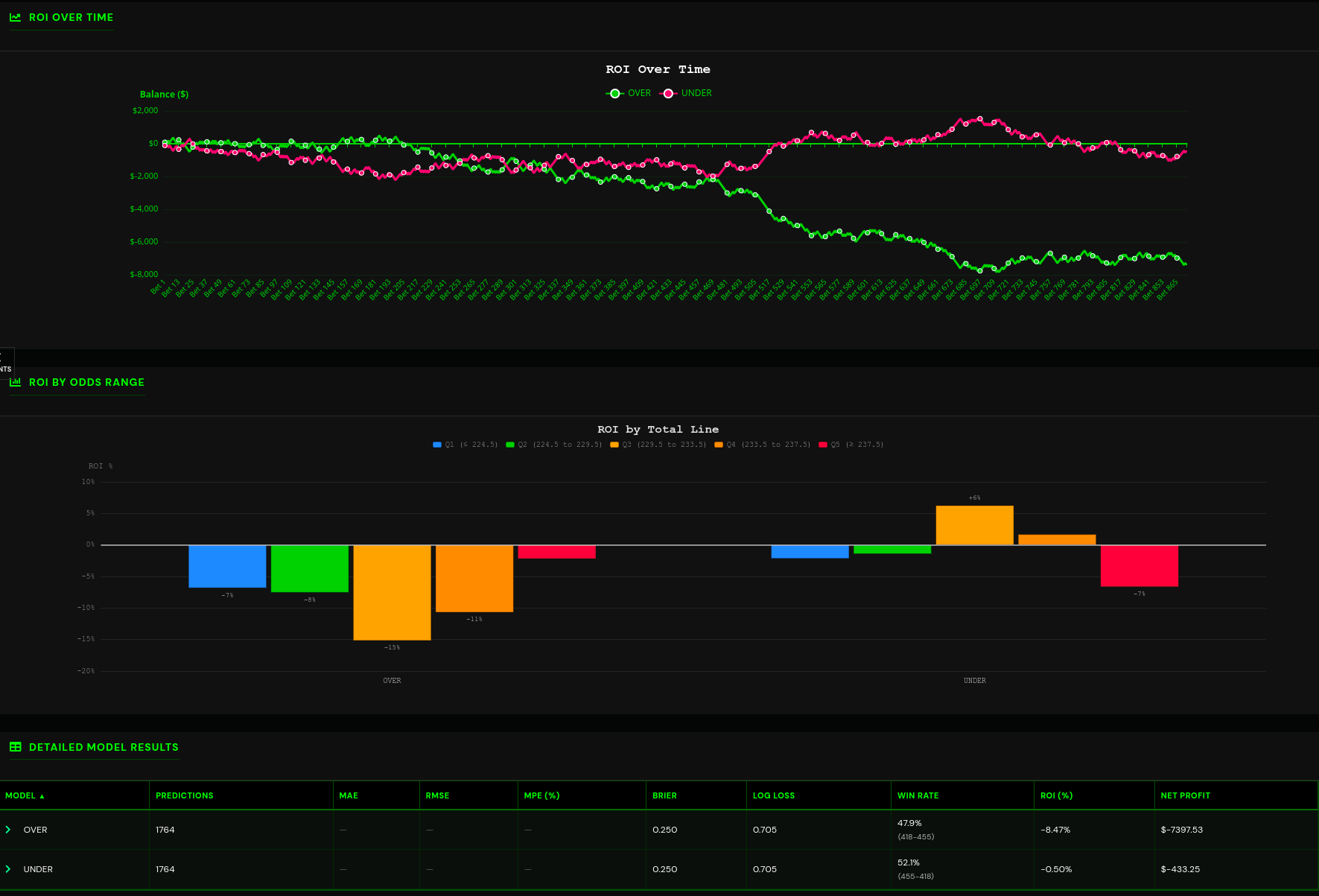
So if one side wins, the other loses, how do you pick a side, especially when the lines move? That is the hard part. Insanely hard. The below image shows that if you always bet the over on DK at 10 minutes before the game started, you would lose 8.47%, going 418-455 (47.9%). Betting the under every time you'd be correct 52.1% and still lose 0.5% of every dollar wagered. If these are -110 odds for both sides, where the house edge is 4.7%, how can you lose 9%? This is because books have better quality data, better modeling, and asymmetrical information-- they can see who is wagering on what, and subtly adjust lines, so the side they view as more likely to win becomes -115 and the dog becomes -105 without moving the line, so you need to win _more_ than the 52.4% just to break even than with normal -110 odds.
So the last example shows that even with 4.7% vig, you can still lose much more. That example was on a liquid market (lots of money wagered) with a "competitive" house take. These markets are "old and boring" where best case scenario you're doubling your money. Everyone wants to go after longshots, so why not combine wagers? Do you see where this is going? When you're giving up a ~5% edge on one wager, and in reality could be losing 10 cents on the dollar (this assumes you randomly bet on these coin flip markets), the same exact math applies when you start to combine wagers. That 5 leg parlay of coin flips has essentially a (0.5 x 0.5 x 0.5 x 0.5 x 0.5) 3.125% chance of happening, but does it pay +3100 or better? Probably not. First you think, "Oh, just use -110 odds", which would put you at the book offering 3.94% odds (+2440), meaning that the parlay's odds are effectively ~26% worse than simply doing the 5 independent wagers. Putting up $20 to win $500 excites our monkey brains much more than doing 5 independent $4 wagers to reduce the impacts of variance (how often will that 3.125% event happen in X iterations), or simply "letting it ride" over time (which still has inherent risks.)
Human Behaviors - "Apes Together Strong"
In Massachusetts, the most educated state in America, over 30% of calls to the Problem Gambling Hotline were actually users wanting technical support for placing their bets on apps-- not seeking help with their gambling problem. We are not a smart population. Humans are social creatures who mimic behaviors of others. Look at meme stocks and see that people want to belong, even if it means doing stupid things. Look in r/sportsbook or r/sportsbetting and you will see that the majority of posts are people posting ridiculous parlays that they just made or posting winning tickets of said parlays. Nobody cares about a $20 moneyline wager, it gets no attention. You need to have a $5k+ ticket to get upvotes. Or a 20 leg ticket filled with -500 sides. The reasons why people wager vary, but can likely be bucketed into "I want money", "I want social acceptance/status/attention", boredom or addiction. Combine any of these and you can explain a lot of things: cults, social media, America, etc.. Where people congregate online will likely determine how they spend their time and money. If they're seeing other people do dumb stuff like doing 8 leg parlays, they will be influenced to do so, too.
The Scale and Profitability of DraftKings
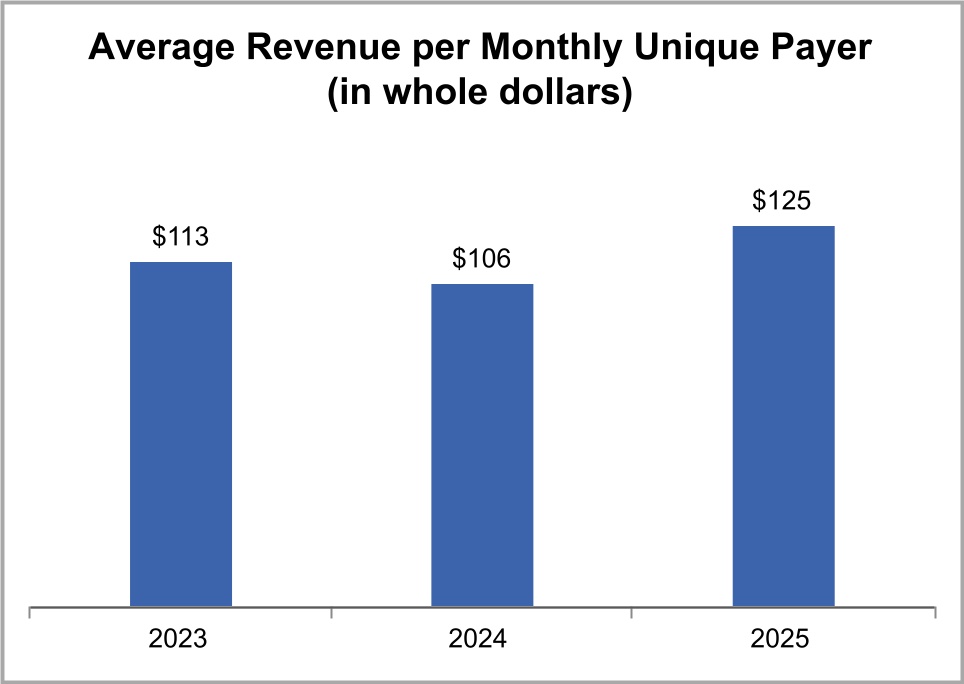
Knowing the background of the average sports bettor helps, but so does understanding how much they lose and how much the books make is also relevant. The 3 major books in America are DraftKings, FanDuel and BetMGM. The latter 2 have lots of other operations in traditional casino spaces and iGaming abroad, so I'll look at DK's most recent 10-K that they file with the SEC for investors. I won't waddle around the bush (get it, Corgis waddle), here is what is early in this document. For active gamblers on DK, they deposit $125 per month. This is across the year, so as sports seasons wane and people go outdoors, this will likely vary (because everyone will have fallen asleep watching baseball, they won't be betting, etc.), but this works out to $1500 of losses per year for your average bettor. Take that as you will.
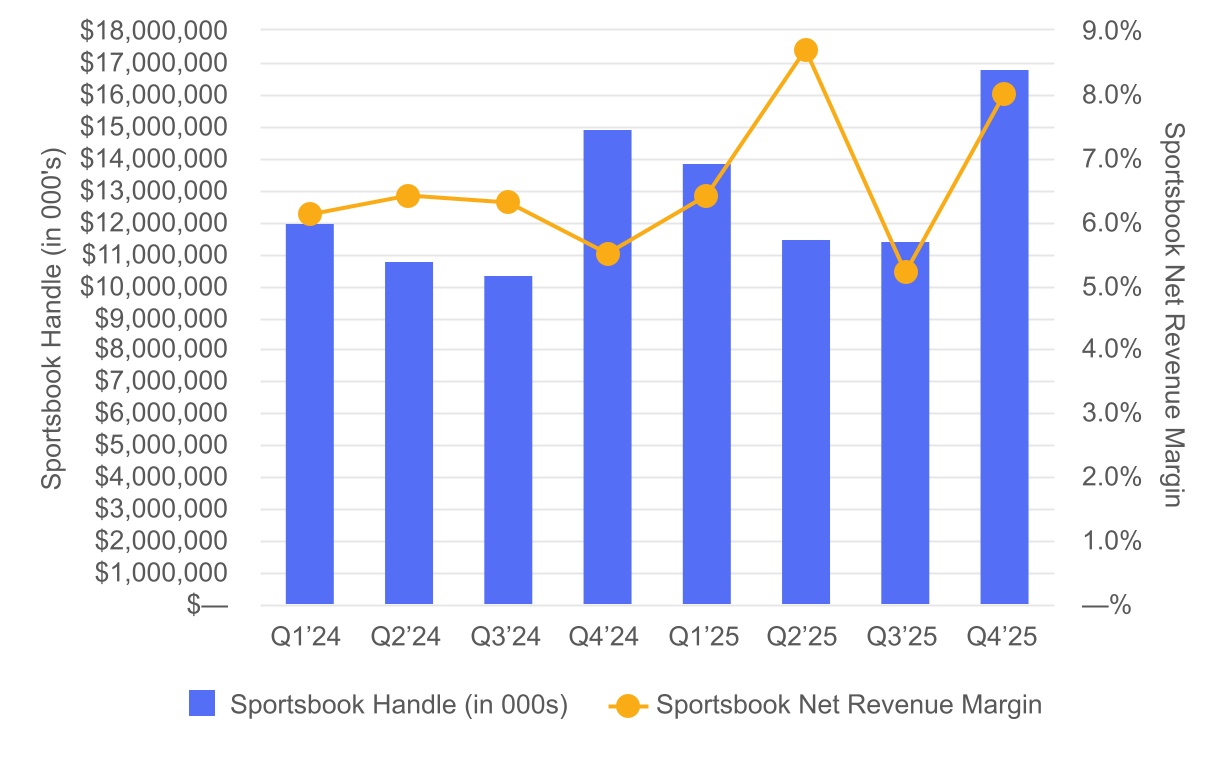
In addition, they publish margin figures. This is simply revenue (dollars deposited) over handle (dollars wagered), so their overall vig. Notice the 8% number for 2025Q4-- that is kind of close to that NBA over/under number for loss ratio on straight wagers as shown above-- almost double what you would expect from -110 sides. This shows that there are multiple ways for the books to adjust their margins up or down. If wagering volume is down, adjust take to increase income. I mean, they have to pay for their commercials and sponsorships somehow. (As an aside, 2025 was DK's first profitable year, 3.7 million net income on $6 billion in revenue. They'll keep growing revenue via more users or higher spend per user, plus more marketing spend, then juice net income by being more aggressive with their margin targets.)
" Sales and Marketing Sales and marketing expenses consist primarily of expenses associated with advertising, conferences, costs related to free to play contests, rent and facilities maintenance and the compensation of sales and marketing personnel, including stock-based compensation expenses. Advertising costs are expensed as incurred and are included in sales and marketing expense in our consolidated statements of operations. Advertising costs include those costs associated with communicating with potential customers and generally use some form of media, such as internet, radio, print, television or billboards. Advertising costs also include costs associated with strategic league and team partnerships. During the years ended December 31, 2025, 2024 and 2023, advertising costs calculated in accordance with U.S. GAAP were $1,124.8 million, $1,049.6 million and $984.4 million, respectively."
The Other Predators in the Bushes
Now you've looked past the books themselves, the "psychology" of social media, the odds and the difficulty of actually picking winners. How do you win? There are dozens of new sites each month popping up promising +EV wagers. Go to any sports betting environment and there will be touts all over offering "1000% cant lose locks" or fixed matches. Social media is full of influencers with expensive cars in fancy surroundings promising the world with amazing picks if you just pay $500 to join their Discord. None of these sources are realistic. People go on heaters, they go cold. Simply flipping a coin for each match you'll typically lose 10 cents on the dollar over a long enough time horizon if you're doing straight bets. But people don't. They want to stack multiple wagers. They want to think they're Ace Rothstein and know something that the data nerds don't. Unfortunately, they don't. The people who are actually profitable betting on sports are going to be the types of people who would themselves be working for the books. They won't be making ridiculous claims about going 10-2 and being up 23 units. They'll be the ones focusing on various scenarios that are mispriced relative to how frequently they occur. It can be finding spots where an event is priced at 25% on books when their own data shows it is 28%. Nobody gets excited over a 3% ROI. But those are the people who are actually making money betting on sports.